
Section :
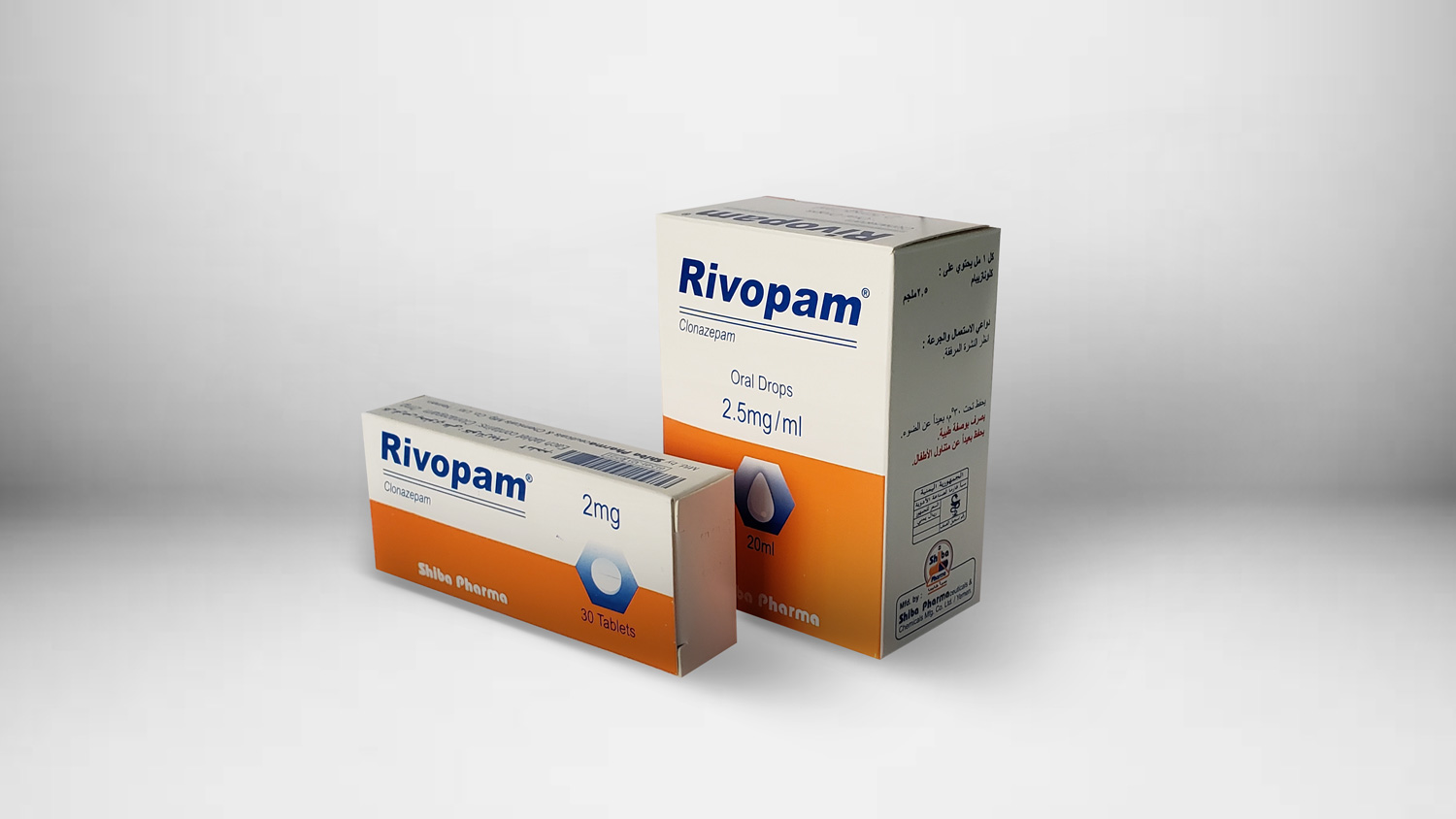
Rivopam Drops & Tabs
📌 COMPOSITION
Each tablet contains: Clonazepam 2 mg.
Each 1 ml of oral drops contains: Clonazepam 2.5 mg.
📌 DESCRIPTION
Rivopam (Clonazepam) belongs to a group of medicines called 'benzodiazepines'. Rivopam enhances the activity of the inhibitory action neurotransmitter Gamma‑Aminobutyric acid (GABA), that is the major inhibitory neurotransmitter in the central nervous system. It acts by binding to the benzodiazepine site of the GABA receptors and decreasing any excessive electrical nerve activity in the CNS that might be contributing to seizures. This inhibition leads to anticonvulsant, skeletal muscle relaxant, and anxiolytic effects.
📌 INDICATIONS
Rivopam is used to treat:
- Epilepsy in infants, children and adults.
- Alone or as an adjunct in the treatment of Lennox‑Gastaut syndrome (petit mal variant), akinetic and myoclonic seizures. It may be useful in patients with absence seizures (petit mal) who have failed to respond to succinimide drugs.
- Panic disorders with or without agoraphobia.
📌 DOSAGE & ADMINISTRATION
It is used with the lowest dose and period as possible. The dosage of Rivopam must be individually adjusted according to the patient's clinical response and tolerance. In order to minimise initial adverse reactions, it should be started with low doses and increased progressively until a maintenance dose suited to the individual patient has been reached. Do not take a double dose (two doses at the same time) to make up for a forgotten dose.
Seizure Disorders:
- Infants up to 12 months: The initial dose is 0.25 mg per day or less, and the dose is gradually increased to 0.5 to 1.0 mg per day.
- Children from 1 to 5 years: The initial dose is 0.25 mg per day or less, and the dose is gradually increased to 1 to 3 mg per day.
- Children from 5 to 12 years: The initial dose is 0.5 mg per day or less, and the dose is gradually increased to 3 to 6 mg per day.
- Adults and children over 12 years of age: The initial dose is 1 mg per day or less, and the dose is gradually increased to 4 to 8 mg per day.
- Elderly people 65+: The initial dose is 0.5 mg per day or less, and the dose is gradually increased to 4 to 8 mg per day. Max dose 20 mg.
Panic disorders:
Adults:
The initial dose is 0.25 mg twice daily. An increase to the target dose for most patients of 1 mg/day may be made after 3 days. Higher doses of 2, 3 and 4 mg/day in that study were less effective than the 1 mg/day dose and were associated with more adverse effects. Some individual patients may benefit from doses of up to a maximum dose of 4 mg/day.
Children: There is no clinical trial experience in panic disorder patients under 18 years of age.
Hepatic Impairment: Patients with severe hepatic impairment should not be treated with clonazepam. Patients with mild to moderate hepatic impairment should be given the lowest possible dose.
📌 RESTRICTIONS ON USE
Contraindications
- Hypersensitivity to Clonazepam or to other 'benzodiazepine' medicines.
- Patients with severe respiratory insufficiency or severe hepatic impairment, as benzodiazepines may precipitate hepatic encephalopathy.
- Dependence on medication.
- Patients with myasthenia gravis, acute narrow‑angle glaucoma.
Precautions
Caution should be taken in patients with:
- Severe liver damage, porphyria (abnormal haemoglobin metabolism).
- Spinal or cerebellar ataxia (where you may become shaky and unsteady, have slurred speech or rapid eye movement).
- Acute intoxication due to alcohol, sleep apnoea.
- Careful dosage adjustment is required in elderly patients and those with pre‑existing disease of the respiratory system, liver or kidneys.
- If the dose of Rivopam has to be reduced or stopped, this must be done gradually to avoid withdrawal symptoms.
- Patients treated with any antiepileptic drugs for any indication should be monitored for the emergence or worsening of depression, suicidal thoughts or behaviour, and/or any unusual changes in mood or behaviour.
- When taking this medicine there is a risk of dependence, which increases with the dose and duration of treatment, and also in patients with a history of alcohol and/or drug abuse.
Use in pregnancy and lactation
Rivopam should only be administered to pregnant women if the potential benefits outweigh the risk to the foetus, as it is known that Rivopam has harmful effects on the unborn child. It should not be used during breastfeeding.
Effects on the capacity to drive vehicles or use machines
The patient should be informed that this medication may impair the ability to drive a vehicle or operate machinery. Therefore, driving, using machines and other hazardous activities should be avoided altogether or at least during the first few days of treatment.
📌 DRUG INTERACTIONS
Caution should be taken when Rivopam is co‑administered with the following drugs:
- Opioids or CNS depressants may result in profound sedation, respiratory depression, coma, and death.
- The antiepileptic medicines phenytoin, phenobarbital, carbamazepine, lamotrigine and valproate may increase the clearance of clonazepam, thereby decreasing the plasma concentration of clonazepam.
- The CNS‑depressant action of the benzodiazepine class of drugs may be potentiated by alcohol, narcotics, barbiturates, non‑barbiturate hypnotics, antianxiety agents, the phenothiazines, thioxanthene and butyrophenone (classes of antipsychotic agents), monoamine oxidase inhibitors, the tricyclic antidepressants and by other anticonvulsant drugs.
📌 ADVERSE EFFECTS
Clonazepam, like other benzodiazepine drugs, causes adverse effects, but not every patient gets them:
- Transient effects that can be prevented by increasing the dose slowly: dizziness, ataxia, somnolence, muscle weakness, headache. In long‑term or high‑dose treatment, reversible disorders may occur such as slurring of speech, diplopia. Rarely, nausea and GIT symptoms may occur.
- In infants and small children: increased production of saliva and bronchial hypersecretion.
- Some effects have been observed such as: decreased platelets, allergic reaction, disturbance of concentration, restlessness, confusion, disorientation, depression, nervousness, anxiety, sleep disturbance.
📌 OVERDOSAGE
Overdosage of benzodiazepines usually ranges from drowsiness to coma. In mild cases, symptoms include drowsiness, mental confusion and lethargy. In more serious cases, symptoms may include ataxia, dysarthria, nystagmus, hypotonia, hypotension, respiratory depression, coma and very rarely death.
Treatment:
- Maintain a clear airway and adequate ventilation if indicated.
- Symptomatic treatment for cardiorespiratory or central nervous system effects, treatment with activated charcoal within 1-2 hours.
- Gastric lavage in case of mixed overdose where no more than one hour has elapsed since ingestion.
- If CNS depression is severe, consider the use of flumazenil only under close monitoring. Haemoperfusion and haemodialysis are not useful in benzodiazepine intoxication.
📌 STORAGE INSTRUCTIONS
Store below 30°C, away from light.
📌 PHARMACEUTICAL FORMS
- Rivopam tablets: Pack of different sizes.
- Rivopam oral drops: Pack of 20 ml.