
Section :
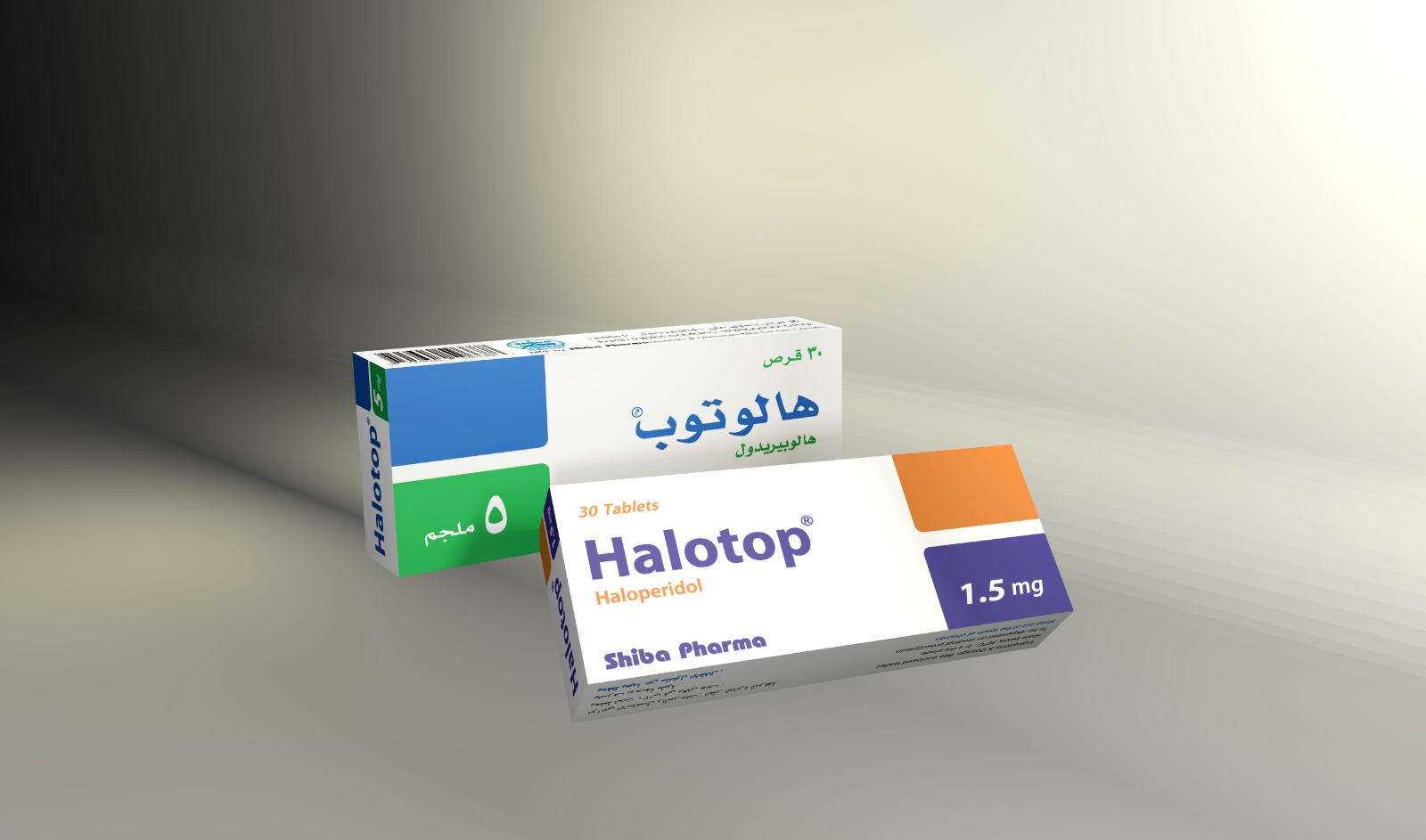
Halotop
📌 COMPOSITION
Each tablet contains: Haloperidol 0.5 mg, 1.5 mg, 5.0 mg.
📌 DESCRIPTION
Halotop (Haloperidol) is a phenylbutylpiperadine derivative with a highly potent antipsychotic effect. It is used for adults, adolescents and children for illnesses affecting the way of thinking, feeling or behaving. These include mental health problems (such as schizophrenia and bipolar disorder) and behaviour by helping to correct chemical imbalances in the brain, which may cause mental illness. Halotop exerts its antipsychotic effect through antagonism of the dopamine receptor, mainly the D2 receptor, and has neuroleptic activity. Haloperidol also binds to alpha‑1 adrenergic receptors, but with lower affinity, and displays minimal binding to muscarinic, cholinergic and histaminergic (H1) receptors.
📌 INDICATIONS
- Mental illnesses such as: schizophrenia, mania, severe anxiety, tension or excitement and severe agitation, hyperactivity or aggression in patients with mental or emotional illness.
- Nausea and vomiting.
- Behavioural problems in children with mental retardation or mental illness.
- Tourette’s syndrome, a condition with uncontrolled vocal outbursts and body movements (tics).
- Short‑term treatment of hyperactive children who show excessive motor activity with accompanying conduct disorders consisting of some or all of the following symptoms: impulsivity, difficulty sustaining attention, aggressive mood ability.
📌 DOSAGE & ADMINISTRATION
Adults:
- (Schizophrenia, Psychosis):
- Moderate diseases: 0.5 - 2 mg every 8 - 12 hours initially.
- Severe diseases: 3 - 5 mg every 8 - 12 hours; not to exceed 30 mg/day.
- (Tourette Disorders): 0.5 - 2 mg orally initially. If severe symptoms necessitate increased dosage, titrate upward to 3 - 5 mg orally every 8 - 12 hours; if the patient remains inadequately controlled, daily doses up to 100 mg have been used (safety not determined).
Elderly:
- 0.25 - 0.5 mg orally every 8 - 12 hours initially, and more gradual adjustment is recommended.
Children:
- (Schizophrenia, Psychosis/Sedation):
- Children younger than 3 years: Safety and efficacy not established.
- Children 3 - 12 years or (15 - 40 kg): 0.25 - 0.5 mg/day orally divided every 8 - 12 hours initially; may be increased by 0.5 mg/day every 5 - 7 days as needed; maintenance: 0.05 - 0.15 mg/kg/day orally divided every 8 - 12 hours.
- Children older than 12 years: Moderate disease, 0.5 - 2 mg orally every 8 - 12 hours initially; severe disease, 3 - 5 mg orally every 8 - 12 hours; not to exceed 30 mg/day.
- (Tourette Disease):
- Children younger than 3 years: Safety and efficacy not established.
- Children 3 - 12 years: 0.5 mg/day orally initially; dose increased by 0.5 mg every 5 - 7 days until therapeutic effect is achieved, then reduced to the lowest effective maintenance level of 0.05 - 0.075 mg/kg/day orally divided every 8 - 12 hours.
- Children older than 12 years: 0.5 - 2 mg orally every 8 - 12 hours initially. If severe symptoms necessitate increased dosage, titrate upward to 3 - 5 mg orally every 8 - 12 hours; if the patient remains inadequately controlled, daily doses up to 100 mg have been used (safety not determined).
- (Behavioural Disorder):
- Children younger than 3 years: Safety and efficacy not established.
- Children 3 - 12 years: 0.5 mg/day orally initially; dose increased as needed by 0.5 mg every 5 - 7 days until therapeutic effect is achieved, then reduced to the lowest effective maintenance level of 0.05 - 0.07 mg/kg/day divided every 8 - 12 hours.
- (Acute Agitation):
- Children younger than 12 years: Safety and efficacy not established.
- Children older than 12 years: 0.5 - 3 mg orally, repeated after 1 hour as needed.
📌 RESTRICTIONS ON USE
Contraindications
- Hypersensitivity to Haloperidol.
- Any patient who has one of the following conditions: Parkinson’s disease, heart disease, brain damage, spasticity, severe depression, breast cancer.
Precautions
Take caution and consult your doctor in the following cases:
- Heart problems, bleeding in the brain, depression, problems with the thyroid gland, difficulty in breathing, blood disease, prostate problems, low blood pressure, eye problems, tremor.
- Tardive dyskinesia: a syndrome consisting of potentially irreversible, involuntary dyskinetic movements may develop with antipsychotic drugs. If symptoms of tardive dyskinesia appear, the drug should be discontinued.
- Neuroleptic malignant syndrome associated with the use of antipsychotic drugs. If it occurs, the patient should discontinue the drug and the symptoms should be managed.
Effect on ability to drive or use machines
Halotop may affect your ability to drive or use machines. Therefore, it is not recommended to drive or use machines if you are taking Halotop without discussing this with your doctor first.
Use in pregnancy and lactation
- Talk to your doctor before taking Halotop if you are pregnant, think you may be pregnant or might become pregnant. The following symptoms may occur in newborn babies of mothers who have used Haloperidol in the last trimester: shaking, muscle stiffness and/or weakness, sleepiness, agitation, breathing problems and difficulty in feeding. If your baby develops any of these symptoms, you may need to contact your doctor. You may still be able to take Haloperidol tablets if your doctor thinks you need to.
- Do not take this medication if you are breastfeeding, because a small amount of the medicine may pass into mother’s milk.
📌 DRUG INTERACTIONS
Caution should be taken when co‑administering Halotop with:
- Antiarrhythmic drugs: cause QT prolongation.
- Drugs that cause electrolyte imbalance (diuretics and corticosteroids): cause hypokalaemia, hypomagnesaemia and hypocalcaemia.
- Dopamine agonists (levodopa): decrease the effect of antiparkinsonian drugs.
- Other antipsychotic agents: potentiate CNS depression.
- CYP2D6 inhibitors (chlorpromazine, paroxetine, sertraline), buspirone: increase plasma concentrations of Halotop.
- Carbamazepine, rifampicin: decrease plasma concentrations of Halotop.
📌 SIDE EFFECTS
- Common side effects: Drowsiness or tiredness, restlessness, agitation, anxiety or excitement, confusion, headaches, muscle weakness, difficulty in speaking and/or swallowing, increased or decreased sweating, dry mouth, indigestion, nausea and/or vomiting, increased appetite, loss of appetite, weight changes, constipation, diarrhoea, increased salivation, insomnia, euphoria, hallucinations, tachycardia, hypotension, blurred vision, hyperglycaemia.
- Other side effects: Extrapyramidal symptoms.
📌 OVERDOSAGE
Symptoms: Muscular rigidity and a generalised or localised tremor; hypertension rather than hypotension is also possible. In extreme cases, the patient may appear comatose with respiratory depression and hypotension that could be severe enough to produce a shock‑like state, with a risk of ventricular arrhythmias, possibly associated with QT prolongation.
Treatment: There is no specific antidote; treatment is supportive, and ECG and vital signs should be monitored. Treatment of severe arrhythmias with appropriate anti‑arrhythmic measures is recommended. Hypotension and circulatory collapse may be counteracted by the use of intravenous fluids, plasma or concentrated albumin, and vasopressor agents. In cases of severe extrapyramidal reactions, parenteral administration of an antiparkinsonian agent is recommended. Dialysis is not recommended in the treatment.
📌 STORAGE INSTRUCTIONS
Store below 30°C in a dry place.
📌 PHARMACEUTICAL FORMS
Halotop tablets: Pack of different sizes.