
Section :
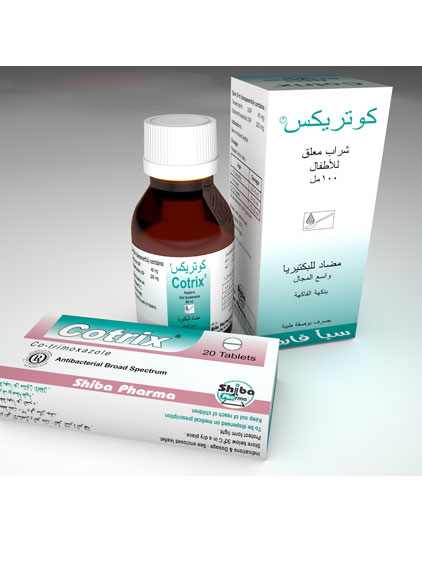
Cotrix
📌 COMPOSITION
- Each 5 ml (teaspoonful) of suspension contains: Trimethoprim 40 mg – Sulfamethoxazole 200 mg.
- Each tablet contains: Trimethoprim 80 mg – Sulfamethoxazole 400 mg.
- Each Forte tablet contains: Trimethoprim 160 mg – Sulfamethoxazole 800 mg.
📌 DESCRIPTION
Cotrix is a dual‑component bactericidal drug that works by inhibiting specific enzymes involved in the biosynthesis of folinic acid, which is essential for bacterial DNA synthesis. Cotrix is rapidly absorbed from the gastrointestinal tract after oral administration, and peak plasma levels are reached within 1-4 hours. The two components are mainly excreted in the urine, with elimination half‑lives of 6-12 hours and 8-10 hours for sulfamethoxazole and trimethoprim, respectively.
📌 INDICATIONS
- Respiratory tract infections, including acute and chronic bronchitis and pneumonia.
- Gastrointestinal tract infections, including enteritis, infective diarrhoea, cholera, typhoid and paratyphoid fever, and traveller's diarrhoea.
- Urinary tract infections, including pyelonephritis and cystitis.
- Pulmonary or systemic infections.
- Toxoplasmosis (parasitic infection).
- Skin, bone and joint infections.
📌 DOSAGE & ADMINISTRATION
Cotrix should preferably be taken with a little food or drink every 12 hours as follows:
- Infants (1-12 months): 2.5-5 ml.
- Children (1-6 years): 5-10 ml.
- Children (6-12 years): 10-20 ml or 1-2 tablets.
- Adults: 2 tablets (maximum 4 tablets twice daily) or 1 Forte tablet (maximum 2 Forte tablets twice daily).
📌 RESTRICTIONS ON USE
Contraindications
- Hypersensitivity to sulfonamides or trimethoprim.
- Patients with severe haematological disorders or severe renal or hepatic impairment.
- Cotrix should not be given to premature infants or full‑term infants during the first few weeks of life.
Precautions
- Caution should be taken in patients with severe allergies, asthma, jaundice or hyperkalaemia.
- Cotrix should be avoided in patients with porphyria.
- Treatment with Cotrix should be discontinued if signs of Stevens‑Johnson syndrome appear.
- Adequate fluid intake is recommended to reduce the risk of crystalluria.
- Regular blood cell monitoring should be performed when Cotrix is prescribed for prolonged periods or for patients with folate deficiency.
Use in Pregnancy and Lactation
Cotrix should not be used during pregnancy, especially during the first trimester, and is not recommended during lactation.
📌 DRUG INTERACTIONS
- Concomitant use with zidovudine may increase the adverse effects of Cotrix, such as haematological disorders.
- Use of ciclosporin with Cotrix may cause temporary renal impairment.
- Taking pyrimethamine in doses exceeding 25 mg weekly may cause folate‑deficiency anaemia when used concomitantly with Cotrix.
- Cotrix may increase plasma levels of anticoagulants, phenytoin, digoxin or methotrexate.
- Concomitant use of Cotrix with diuretics increases the risk of thrombocytopenia.
📌 ADVERSE EFFECTS
The adverse effects of Cotrix are generally well tolerated. Common effects include oral or vaginal candidiasis, headache, nausea, diarrhoea and skin rash. Very rarely, difficulty in breathing, mouth ulcers, jaundice or muscle weakness may occur.
📌 STORAGE INSTRUCTIONS
- Suspension: Store below 30°C, protect from light.
- Tablets: Store below 30°C in a dry place, protect from light.
📌 PHARMACEUTICAL FORMS
- Cotrix Oral Suspension for Children: Bottles of 50 ml and 100 ml.
- Cotrix Tablets: Pack of 20 tablets and hospital packs of different sizes.
- Cotrix Forte Tablets: Pack of 10 tablets and hospital packs of different sizes.